Call Now: 612-462-2610 · Free Estimates · Open 7 Days
Nova Concrete
Concrete Walkways Built for Curb Appeal and Durability

Bloomington, MN

Concrete Walkways Built for Curb Appeal and Durability

  • Licensed & Insured
  • Free In-Home Estimates
  • Serving the Twin Cities metro
Driveways Patios Stamped Concrete Garage Slabs
4.8/5 from 66 Google reviews
Trusted
By Local Homeowners
Fast
Response Time
4.8-Star
Rated on Google
100%
Licensed & Insured

Bloomington, MN

Get to know Nova Concrete

A walkway is more than a path from one point to another. It's the first thing guests walk on, the last thing they look at, and one of the most structurally exposed surfaces on your property. At Nova Concrete, we pour and finish concrete walkways that hold up through freeze-thaw cycles, heavy foot traffic, and Minnesota winters without cracking, settling, or becoming a trip hazard. We've been doing this for 12 years, we're fully insured, and every walkway we install comes with a 1-year warranty. If you're comparing quotes, call us at (612) 462-2610 before you sign anything.

A properly built concrete walkway starts with the sub-base. Skip that step, and it doesn't matter what finish you put on top. We excavate, compact the base, set forms at the right grade for drainage, and pour with adequate reinforcement for the soil conditions and load it'll see. Width, thickness, finish type, and site access all drive the final cost. Decorative options like stamped concrete or exposed aggregate run higher than a standard broom finish, and longer runs with grade changes cost more than a flat, straight path. Cost typically ranges from $1,500 to $8,000 or more depending on scope. Every job is different. Contact Nova Concrete for an accurate estimate.

What Goes Into a Concrete Walkway That Actually Lasts

Most walkways that crack within a few years weren't poured wrong. They were built on a bad base. We start every walkway job by excavating down to stable soil, then compacting a gravel sub-base that gives the slab somewhere to sit that won't shift when the ground freezes. That's the part homeowners never see, which is exactly why some contractors skip it. We don't. Reinforcement gets placed before the pour, concrete is finished to the right texture for traction, and control joints are cut at the correct intervals to manage natural expansion. The finish is the last step, not the only one.

What we do

Walkway Finish Options: Which One Fits Your Property

Standard broom finish is the most common choice because it's durable, slip-resistant, and clean-looking. But it's not your only option. Stamped concrete lets you replicate the look of stone, brick, or wood grain with the structural performance of concrete. Exposed aggregate gives the surface a natural, textured appearance by revealing the stone within the mix. Colored concrete ties the walkway into the broader aesthetic of your home. We work on both residential and commercial projects, and we'll help you pick the finish that fits your budget, your traffic levels, and the look you're going for. None of these finishes are gimmicks. All of them require the same solid base underneath.

Broom Finish

The practical standard. Textured for grip in wet conditions, clean in appearance, and the most cost-effective concrete walkway option. Works on any style of home.
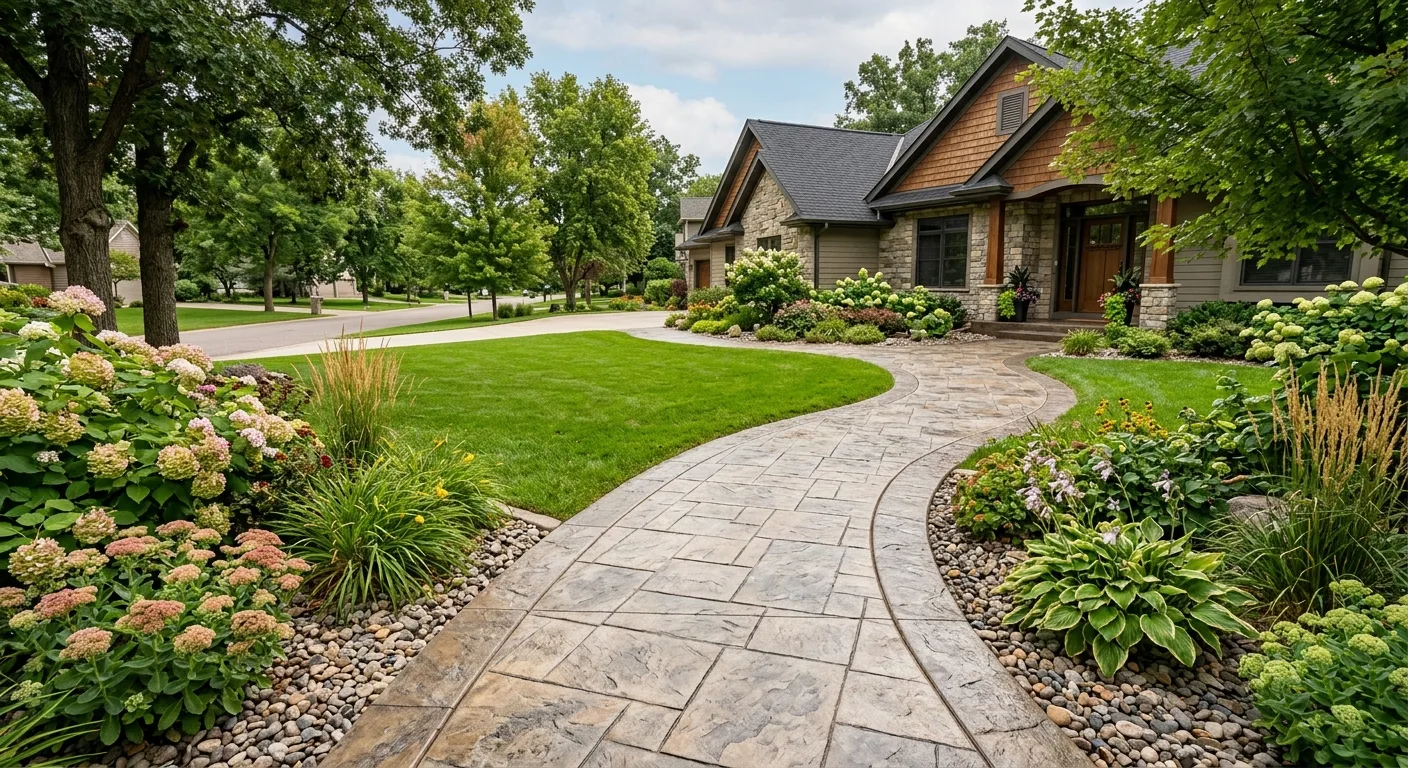
Stamped Concrete

Pressed patterns that replicate stone, brick, or slate. Excellent curb appeal without the maintenance demands of actual pavers. Sealed to protect color and pattern long-term.

Exposed Aggregate

Surface paste is washed away during finishing to reveal the natural stone in the mix. Distinctive texture, strong grip, and a look that holds up without needing much upkeep.

Colored Concrete

Integral pigment mixed directly into the concrete before pouring. Color runs through the full slab depth, so surface chips or scratches don't expose a gray core underneath.

When to Replace a Walkway Instead of Patching It

We get asked this constantly, and the honest answer is: if the slab has moved, patch it and the problem comes back. Surface cracks from normal shrinkage are cosmetic and can often be filled. But if sections have lifted, dropped, or separated at a control joint, the sub-base has failed. No patch holds on a compromised base. Replacing a settled walkway also gives you the chance to correct drainage problems, which is often what caused the failure in the first place. If your walkway is more than 20 years old and showing multiple issues, replacement is almost always the smarter investment. We'll tell you the same thing in person that we'd tell a neighbor.

The Nova Concrete Walkway Process, Start to Finish

We come out, look at the site, and give you a real number. No vague ranges, no bait-and-switch after the contract is signed. Once you're ready to go, we handle the full scope: excavation, forming, base prep, pour, finish, and any decorative work you've selected. We don't subcontract the pour out to someone else. If you've got steps connecting to the walkway, we tie those into the same job so everything matches. We also connect walkway work to driveway projects when you're updating the whole front approach at once. After the pour, we walk you through the cure timeline and what to avoid while the concrete reaches full strength. The 1-year warranty covers our work. If something's wrong, call us and we fix it.

Our work

Recent Walkway Projects

A sample of concrete walkway work we've completed across the Twin Cities metro.
walkways work — professional service in Bloomington, MN

Free estimate

Get a Walkway Estimate from Nova Concrete

Ready to replace a failing walkway or install a new one? We're open seven days a week. Call (612) 462-2610 or visit our quote page to start the conversation. We'll give you a straight answer on scope, timeline, and cost.

Or send us your info

Reviews

What Twin Cities Homeowners Say

Rated 4.8/5 from 66 Google reviews

“I had a great experience with NOVA. I got a quote, I ended up adding to it the day of…and they accommodated my request. They are fast, clean and do excellent work. I’m very pleased with the product and will be using them again for the next project. Highly recommend.”

Amos J Olivarez Verified Google review

“Had the team from Nova come and completely redo my front steps and patch up cracks in my foundation. They did an amazing job and the work was done quickly and went very smooth. Plus they are just good people! Highly recommend!”

Colin Owens Verified Google review

“I had a really great experience with Nova Concrete LLC. They worked on my driveway and patio, and everything turned out exactly how I hoped. The crew was easy to work with, showed up on time, and clearly knew what they were doing. They paid attention to the little details, and it really shows in…”

Ashley Trevino Verified Google review

FAQ

Frequently Asked Questions

What's the cheapest way to make a walkway? +
Poured concrete with a standard broom finish is one of the most cost-effective permanent walkway options. It outlasts pavers in freeze-thaw climates, requires less maintenance than gravel or stepping stones, and doesn't shift or sink the way loose materials do. The upfront cost is higher than gravel, but the total cost over 20 years is almost always lower. We won't recommend the cheapest option if it's going to fail in five years.
What do you mean walkway? +
A walkway is a defined, surfaced path connecting two points on a property. That includes front entry paths from the sidewalk to the door, side yard passes between house and garage, backyard connections to a patio or outbuilding, and any paved pedestrian route that's separate from a driveway. We design and pour concrete walkways for all of these applications, including grade changes, step integration, and connections to existing concrete slabs.
What is the cheapest walkway? +
Among permanent surfaces, broom-finish concrete is consistently the lowest cost per square foot when factoring in installation and long-term maintenance. Gravel and mulch paths cost less upfront but need replenishment and don't hold edges well in cold climates. Pavers cost more to install and individual units can shift or crack over time. For a walkway that's going to see daily use through Minnesota winters, poured concrete gives you the best value.
What are some common types of walkways? +
Common options include broom-finish concrete, stamped concrete, exposed aggregate concrete, poured concrete with integral color, natural stone, concrete pavers, and brick. We work exclusively in poured concrete because it performs better structurally in freeze-thaw conditions than assembled unit materials. Pavers look great on paper, but individual units heave and settle over time in climates with hard winters. A single monolithic concrete slab handles temperature movement more predictably.
How thick should a concrete walkway be poured? +
Standard residential walkways are poured at four inches thick. In areas with heavier traffic, vehicle crossings, or poor soil conditions, we increase thickness to five or six inches and adjust reinforcement accordingly. Pouring too thin is one of the most common causes of cracking walkways we see when homeowners call us to replace someone else's work. The slab needs adequate depth to distribute load without flexing.
How long does a concrete walkway take to cure before it can be used? +
Light foot traffic is generally safe after 24 to 48 hours. Full curing takes 28 days, but you won't need to wait that long for normal use. We'll give you a specific timeline based on the mix design, weather conditions, and whether the surface received a sealer. Driving on it or placing heavy loads before the concrete reaches adequate strength will leave permanent marks. We walk through this at the end of every job so there's no guesswork.
Do concrete walkways need control joints, and why? +
Yes. Control joints are intentional score lines cut or tooled into the surface at regular intervals, typically every six to eight feet on a standard walkway. Concrete expands and contracts with temperature changes. Without control joints, the slab cracks randomly. With them, any cracking that does occur is guided to the joint where it's less visible and easier to address. Skipping control joints is a shortcut that creates ugly results. We cut them on every job.

Related